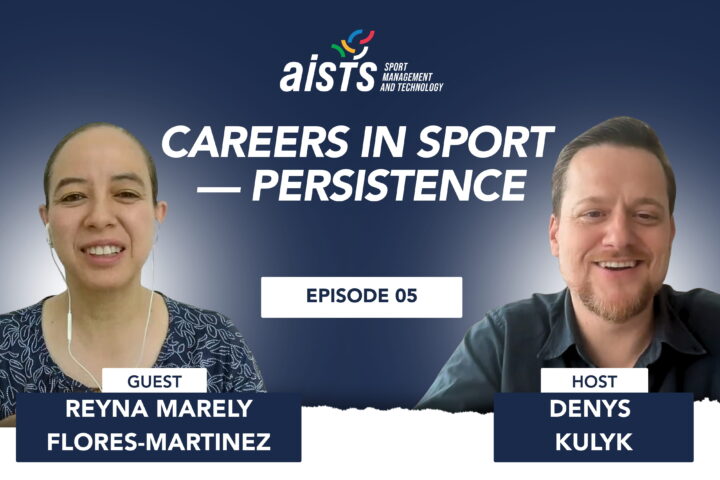

Careers in Sport, hosted by Denys Kulyk, continues with its fourth episode. The series features AISTS alumni working across the global sport industry, with each episode exploring a different theme through one guest’s career. After Kristian D’Amore on Trajectory, Pouya Yaghoubinia on Transition and Céline Beaurain on Guidance, this episode turns to Evolution: how a newsroom leader from Salvador, Brazil, reinvented herself in Switzerland.
Who is Camila Cintra?
Camila Cintra completed her Master of Advanced Studies (MAS) in Sport Management and Technology at AISTS in 2016. She joined CAA Eleven in January 2016 as Media Rights Account Coordinator, moved up to Media Rights Account Manager in 2018, and has been Senior Media Rights Account Manager since October 2020. She is co-responsible for sales in Latin America.
Before AISTS, she spent more than a decade in Brazilian journalism, as Editor and Head of Journalism at Grupo Metrópole in Salvador and as a sports commentator at TVE.

Senior Media Rights Account Manager at CAA Eleven
Leading a Newsroom in Salvador
Camila started as a weekend intern and ended up running the newsroom at Grupo Metrópole. The group gave her real freedom: “If I would come to him to propose like, let’s start a program like this, yeah, you start tomorrow.”, “they gave me the opportunity to literally learn by doing and experience a lot ”
She did a bit of everything, “from discussing rights acquisition until being the reporter on site.” What she is proudest of is people. Former colleagues still call her before accepting a new offer, and she tells them: “you will open doors to other ones and you deserve it.”
She also admits that carrying so much responsibility so young means she would act differently in some situations today. It is not regret, she says. “I did the best I could given the conditions and the knowledge I had.”
Earning Her Place in Football Media
Camila covered football in a media industry that has long been male-dominated. In Brazil, she reported on two FIFA World Cups, the 2013 Confederations Cup, three UEFA Champions League finals and the Copa América. She says her colleagues respected her, and she never wanted to be anywhere because of her gender. “I never wanted to be anywhere just because I was a woman.”
The standard was still high. “I was not allowed to make mistakes, live on the microphone. I needed to be, and to know, beyond 100%.” On a radio show where listeners could call in live, she also learned to handle aggressive comments, and says it made her stronger.
Small moments added up. When male colleagues offered to carry her luggage, she said no. “I was like, I will not do anything that could close the door for the next one.”
Today, she sees progress but believes decisions are still largely driven by men. Her hope is simple: “I’m a person working in sport.” She also argues that diversity goes beyond gender, and that sports organisations should include more nationalities, smaller footballing nations included.
Disconnecting to Move On: From Salvador to Lausanne
In her early thirties, Camila led the group and was proud of it. Still, she knew she had to move. “I was so strongly connected with them that in order to even look at my next step, I had to disconnect.” She wanted to get closer to sport and find a calmer life: “Journalism is 24-7. There’s no stop.”
She chose AISTS for its place in Lausanne, the Olympic capital, and applied with only two or three days left. What she remembers most is her cohort of 40 participants from 27 nationalities. “The best that I had was the day-to-day with the classmates.”
From Journalism to a Sports Media Rights Career
Camila never aimed at media rights. “I was not looking into media rights, I was open to opportunities where my experience could make my application anyhow valuable.” While finishing AISTS, she was looking for an internship. A position at CAA Eleven appeared in January 2016. Her experience carried over.
Today, Camila sits in the account management team. Once a sale is signed, her team handles the implementation of the contract. “We are literally responsible for the contracts and everything that needs to be done so the TV channel exploits to the maximum level the rights that they have acquired.” That covers commercial activation, content and on-site facilities.
What a Broadcaster Really Buys?
A broadcaster buys exclusivity: it is the only one allowed to air the matches. It also buys access to the studios, the interviews and the production around the event. Rights holders get the first layer of access, so players speak to them first, then to everyone else. Prices vary widely from one country to another. Camila points to whether the national team qualifies, how fast the market grows, the size of the population, the local economy and whether the event is a listed one that must air on free-to-air channels.
Challenging the Rules, Courting a New Audience
Speaking from principle, not on behalf of CAA Eleven or UEFA, Camila sees friction between sports organisations and broadcasters as healthy. Rules must exist, but “the rules should be challenged.” Her example is Cazé TV, a Brazilian YouTube channel that, she says, held the Euro 2024 rights and broke broadcast records: “They proved that yes, a YouTube channel can deliver.” She welcomes streamers and influencers, who reach young viewers who “do not have the patience.” Live sport remains a rare exception: “sport is one of the last possibilities for live event where people still stay watching.”
Luck, Discipline and Where She Comes From
How much of her career is hard work, and how much is luck? Camila refuses to separate them. “It’s luck, right people. You find them, they find you, if you are a hard worker.” She traces her discipline to childhood. As a swimmer, she learnt to put in countless hours without knowing where they would lead. She carried “this mindset from my childhood” into life. Brazil shaped her too. “In Brazil we are survivors,” she says. Her parents came from a very poor family and graduated only after becoming parents. She was at both graduations. Moving to Switzerland as a student meant putting her savings into a fresh start. It was not easy. Would she do it again? Yes, without hesitation.
Why Sport?
“I think sport talks to people without the need for translation.” A World Cup match or an Olympic gold medal triggers emotion whatever your age or background, she says. “You don’t need a subtitle, you don’t need an explanation.” For Camila, sport is “the only thing delivering that human side of ourselves to date,” and she feels “blessed” to work in it.
Watch the Full Interview
To discover Camila’s full story, from the newsroom in Salvador to the media rights desk at CAA Eleven, watch the complete interview here.
Watch the first three episodes of the series:
- Careers in Sport – Trajectory: Kristian D’Amore
- Careers in Sport – Transition: Pouya Yaghoubinia
- Careers in Sport – Guidance: Céline Beaurain