Is it really selling a new competitive sport, or has it simply found an exceptional way to package fitness, competition, and community into a repeatable commercial product?
Working at HYROX MUMBAI 2026 has left me with more questions.
Critics argue it’s a well-planned, highly commercialized business model where athletes pay a premium to participate. But if HYROX is simply a clever business model, why do athletes keep coming back?
This has been my initial observation when I was volunteering at the athlete check-in counter: Some athletes kept coming back each day, some even on the same day for another race. As an outsider to the sport, but trying to be an insider in the sports industry, what really got me was: why would people keep paying to participate in the same race? It’s the same course in literally the same order. And yet you have people flying from different countries to participate.
That takes me to the reward system. Measurable results for your work that’s going to be in the HYROX portal – something tangible that motivates people to better their performance: if I train 3 more months, then can I reduce the time by 15 seconds? This is a direct comparison with yourself and not with someone else. And if you keep getting better, then there is the thrill of ranking and travel. And you know, the beauty of this sport is that the categories don’t end at seniors, where everyone after 21 years is put in the same box, which shows what a sport can do when it puts inclusivity at the forefront. Qualification and ranking are based on a really broad category, and everyone seems to get rewarded for their efforts. And the crowd that comes to compete and watch really gives you a sense of belonging, which is what everybody wants to feel at the end of the day.
Measurable results are one aspect of the return, but watching athletes repeatedly put themselves through the same demands made me think about something I had been reading in Mihaly Csikszentmihalyi’s Flow. The central idea of flow is that people can become deeply absorbed when the challenge they’re facing closely matches their perceived skill, with clear goals and feedback. HYROX has several ingredients that could create that environment. It has clear goals; the feedback is immediate; the progress is measurable and also tailored to that independent athlete; skill development that, at this point, is very accessible to a majority of the crowd; the official results page; the photographs during the game act as a visible achievement; the community, the spectator and the other athletes become social reinforcement.
I am not saying the founders crafted the race by following the guidelines of flow, but watching athletes return for another race made me think about something I read in Mihaly Csikszentmihalyi’s Flow: what happens when a challenge is difficult enough to demand our attention but achievable enough to feel possible?
But before people come back, you first have to make them want to come in. So how did HYROX make a relatively new sport feel like something people wanted to be part of?
HYROX is often described as a great marketing machine. But what fascinates me about that statement is the irony: for a company that has grown from a single event in Hamburg in 2017 into a global sports property, how much of that growth actually came from traditional advertising?
According to HYROX’s own Chief Growth Officer, it built its growth without paid influencers or media spend. So how do you market a sport without constantly paying for marketing it?
Perhaps the answer is that HYROX has built the marketing into the sport itself. But how?
Inclusivity plays a very big role here. A prime example of what can happen when Inclusivity becomes your important pillar. The range of people who come to race creates stories that are almost impossible not to share – a 30-year-old running alongside his father. A father competing with a personal reason that has nothing to do with a podium. A grandmother coming back for her 2nd race. New mothers compete while their newborns cheer from the sidelines. Athletes with disabilities. Mother-to-be choosing to participate. Each of these stories gives the sport a human face. The athletes become the story. The story becomes the content. The content creates curiosity, and the curiosity brings in the next athlete.
It’s one thing to understand that human stories are key to great marketing, but another to weave them into the race experience. HYROX also seems to understand that the moments shouldn’t end when the athletes cross the finish line. HYROX uses facial recognition technology to help you quickly find and download your personal race photos. Because thousands of athletes compete at every event, finding pictures manually or by bib number becomes a hassle. To solve this, HYROX partners with an official photography service called Sportsgraf. Here’s how it works: athletes give consent to be photographed and receive a band. Post-race, you are provided with a link with instructions, and that’s it; athletes now have all pictures to share for their social media.
It seems like a small feature in the athlete experience, but from a marketing perspective, it’s fascinating. The event creates the experience, captures the experience, and gives the athletes the tools to share the experience. And the athlete then becomes another point of distribution for the brand.
Experience → achievement → story → share → curiosity → participation.
At this point, marketing isn’t something happening outside the sport. It has become part of the show itself.
Another important question to ask is: how is this quality and standard maintained across the world? This has definitely been possible because of the technology HYROX uses to track athletes’ performance.
The advanced RFID timing chip given to every competitor at check-in, paired with mat sensors placed across the running course and workout stations, is standardised globally, allowing athletes to compare their times on a global leaderboard. This definitely is the USP of this race. It also makes the race as international as possible. This technology helps HYROX maintain its consistency across the world. The athlete in Mumbai needs to believe their performance is comparable to the athlete in London or the USA.
But the major question one has to ask is: How do you build a global sports product without losing control of the experience? HYROX can standardize the sport, but Mumbai still has to deliver, and those aren’t the same thing. HYROX globally controls the race format, rules, judging protocol, timing, branding, qualification and athlete data. Regionally delivered are venue, staffing, volunteers, crowd management, event logistics, and spectator experience. And that was delivered by Yoska Technology Solutions. They were the event partners delivering the global experience.
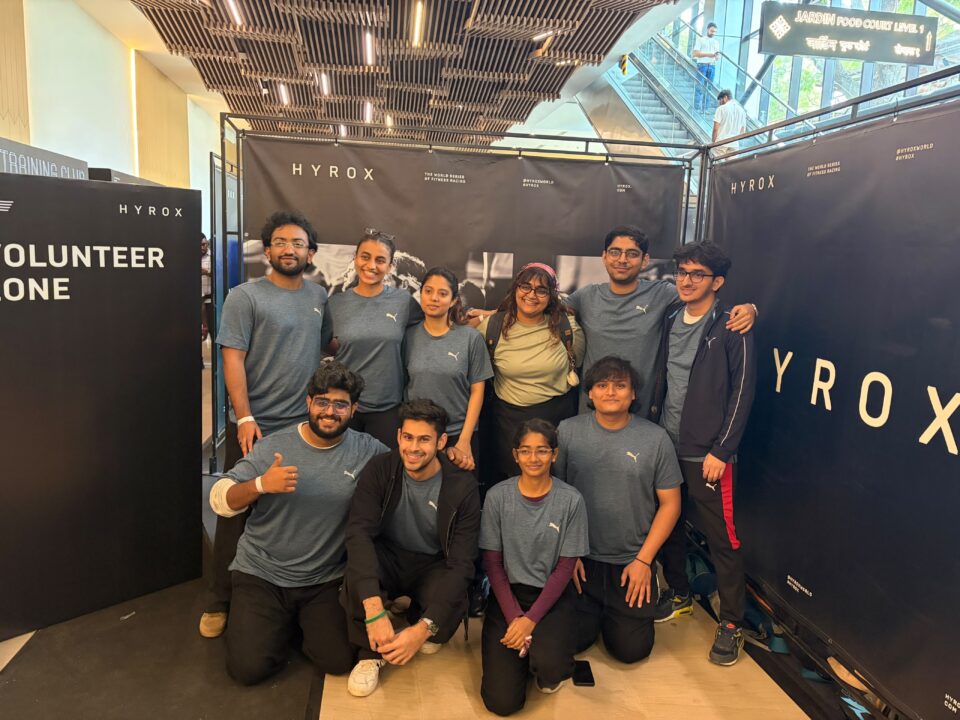
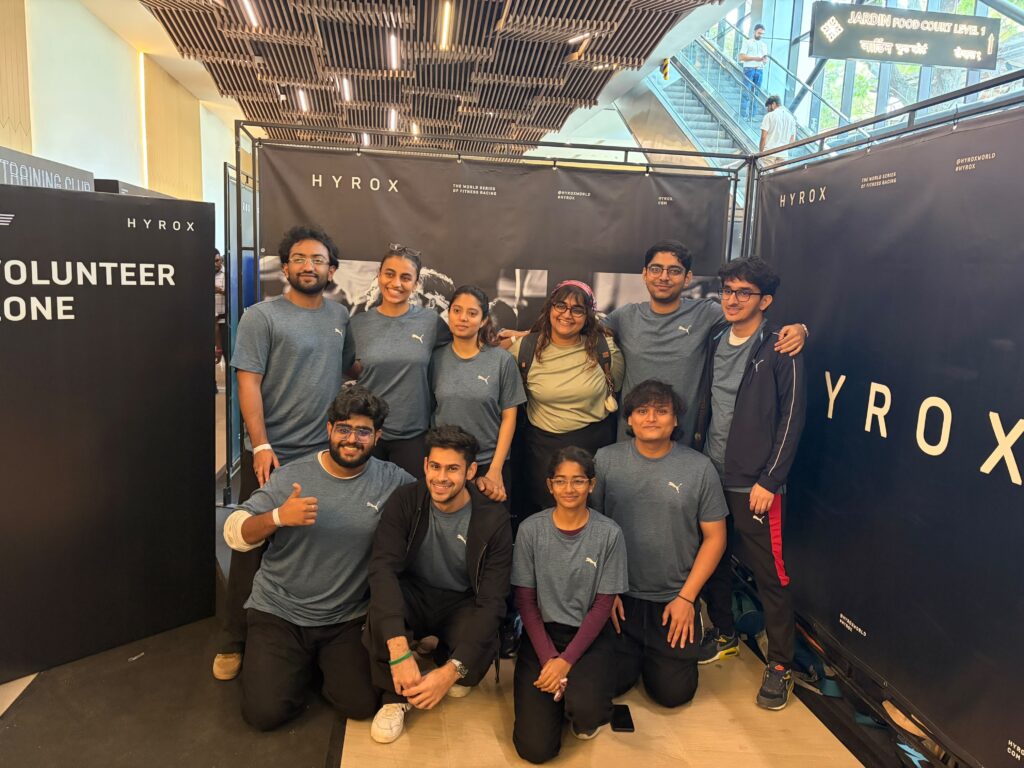
Working at HYROX Mumbai made me realize that the HYROX brand wasn’t delivered by the logo on the wall. People were delivering it. Hundreds of volunteers and judges, event staff, operations teams, managers, local organisers, all local to the country. And this bridge between a global sports property and the local experience is what truly fascinates me. Because you are telling me that the person responsible for an athlete’s initial experience is also someone with little to no experience or training. This is honestly very ironic and impressive. The athletes interact with the volunteers, and the level one judges the most, and these people are not permanent employees; despite that, the operations flow so smoothly.
But we all have that phrase: “Let’s cross that bridge when we get there.” Well, standing at the athlete check-in counter, I realised I was quite literally there.
And this is where the conversation gets a little uncomfortable.
Not because the bridge doesn’t work. It clearly does. An event of this scale, with so many moving parts and so many temporary people coming together, functioning as smoothly as it does, is an achievement in itself.
The growth itself is difficult to ignore. HYROX Mumbai went from around 1,500 participants in 2025 to around 15,000 in 2026. Scaling an event that dramatically in just a year requires serious operational capability, coordination, and people who know how to make a complex event work.
And that is precisely why I don’t think the question is whether the system works. It clearly does.
The more interesting question is: what happens when a system that has already proven it can work at scale asks itself how much better it can become?
Success does not necessarily mean there is nothing left to improve. In fact, rapid growth can make areas for improvement more visible. And standing on that bridge, I found myself looking not at what had gone wrong, but at where the experience could be better. In the long run, the answer to this question determines whether this is a temporary trend or a permanent shift.
We spend so much time talking about the athlete experience, but what about the experience of the people responsible for creating it?
Volunteers, judges, event staff, team leads, and operations teams translate a global sports property into a local experience. They keep the athlete journey moving, but how much training, autonomy, clarity, and support do they have while doing it?
The question became particularly interesting to me after I started observing the structure HYROX has to retain athletes. Could we apply that structure to employees? If so, does that exist? And if not, what would it look like? This also made me think beyond HYROX.
We talk a lot about building better athletes, better leagues, better events and better fan experiences. But as the Indian sports industry grows, we need to build another ecosystem alongside it: the people who make it all possible.
Athlete retention has become a concept sports organisations understand well. Give an athlete a challenge, measurable progress, recognition and a reason to come back, and you create a stronger relationship with the sport.
Could the same thinking apply to the sports workforce?
Responsibility → autonomy → recognition → fair treatment → belonging → return.
This can determine whether someone wants to build a career in sport.
This is especially true in India, where the sports industry is expanding rapidly and creating opportunities to enter the sector through events, leagues, teams, academies, media, technology, and operations.
The same principle that makes athletes return to a sports property applies to the people working inside it: people are more likely to stay where they can see progress, feel ownership and believe their contribution matters.
And maybe that is the bigger question for a sports industry that is still building itself.
This brings me back to my original question: what exactly is HYROX selling?
Maybe it is selling more than a race.
It’s selling Indians an opportunity to participate in a sport that does not revolve around cricket. It’s selling a format where fitness becomes competition, progress becomes measurable, participation becomes community, and athletes have a reason to come back.
But what makes HYROX most interesting for India is not just the sport itself. It is the structure behind it.
A globally standardised product, locally delivered. Technology that makes performances comparable across countries. A format that creates repeat participation. A community that turns competitors into returning customers. And a workforce that has to translate all of this into an experience on the ground.
For a sports industry in India that is growing beyond its traditional boundaries, there is a lot to learn here.
So maybe the question is no longer “What exactly is HYROX selling?”
Maybe it is:
“What can Indian sport learn from what HYROX has built?”
By Suprajha Rajan